
Model
Cartography, reusable world pieces, and objectives turn scattered experience into usable structure.
This page explains the system and orients you according to what you want to do now: understand the method, build your map, organize your world, define objectives, and take it into real cases without jumping between screens.
SELFTRACE works best when you understand it as a cycle: you model reality, work a case with that model, and then correct the system with what you learned.
Cartography, reusable world pieces, and objectives turn scattered experience into usable structure.
Apply uses that structure to work on a real problem with more context and less improvisation.
Each intervention can correct the objective, the reading, or the model pieces that were incomplete.
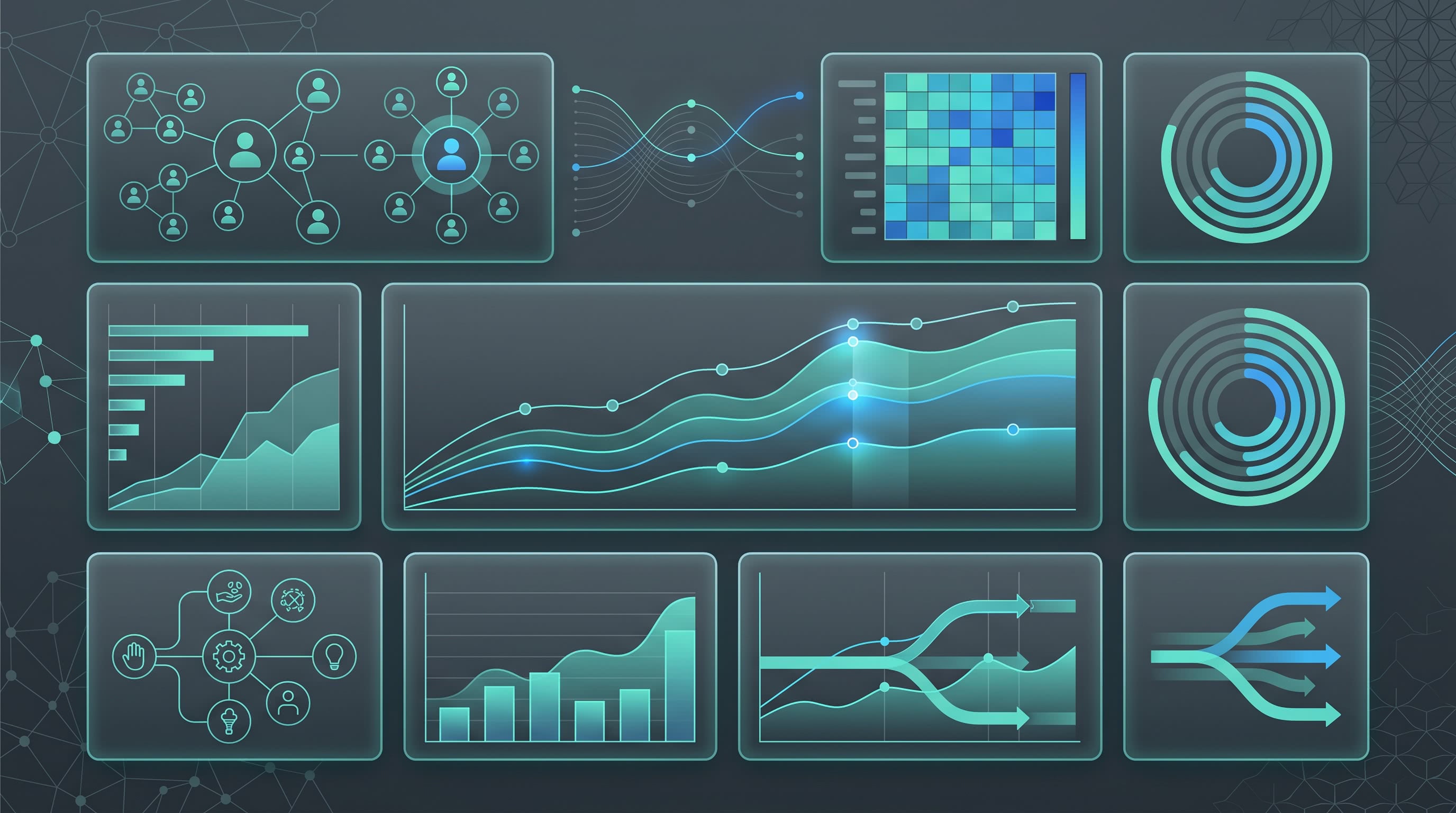
The platform is no longer only a question session. It works better when understood as a process: personal map, world model, objectives, and apply.
Defines patterns, areas, contexts, synthesis, confidence, and interpretive limits.
Builds evidence by rounds and makes profile variation visible by area and context.
Turns the map into usable pieces: relational entities, social entities, contexts, environments, and readings such as `What can I know about myself`.
Introduces direction. It connects the map, the reusable base, and context so the work does not become ambiguous before entering Apply.
Takes the profile into `Apply`, `History`, case cards, shared profiles, interaction, and reusable libraries.
Instead of reading the whole explanation in sequence, enter through the right intent and leave the deep detail for later.
To understand what SELFTRACE models, what its limits are, and what a reading really means.
To move from the method into the real experience of `What can I know about myself`, the integral map, and the new cross-cutting syntheses.
For when you already understand part of your map but do not want to jump straight into Apply without a clear target and a base context.
To see how cartography becomes real case files through `Apply`, case inventory, dedicated cards, and reusable pieces.
SelfTrace is not a personality test. It detects behavioral patterns inside real micro-situations so you can understand how you tend to act under pressure, in relationships, at work, and across other life areas.
1. You choose what you want to work on -- a real concern, a recurring situation, or a pattern you want to explore.
SelfTrace currently tracks 15 behavioral patterns. Examples include avoidance, overadaptation, clarity-seeking, acceptance, rumination, cognitive flexibility, proactive initiative, self-compassion, values clarity, and attachment patterns.
Objectives now organize direction between what SELFTRACE has already read about you and what you want to move in real life.
SelfTrace is built on three validated psychological frameworks. Each pattern in the system links to a specific construct from peer-reviewed research.
Based on Acceptance and Commitment Therapy (Hayes, Strosahl & Wilson, 2006). The Hexaflex model measures 6 processes of psychological flexibility. SelfTrace covers 5 of 6: acceptance, cognitive defusion (via cognitive flexibility), present-moment contact (via conscious regulation), self-as-context (via clarity-seeking), and values-based action.
Trait-level mapping using the Five-Factor Model (Costa & McCrae, 1992). SelfTrace patterns map to specific Big Five facets -- for example, rumination maps to the Neuroticism facet of self-consciousness, and proactive initiative maps to Extraversion's assertiveness facet. Approximately 55% of Big Five facets are currently covered.
Relational pattern detection based on the Experiences in Close Relationships scale (Brennan, Clark & Shaver, 1998). SelfTrace detects both anxious attachment (scanning for rejection, seeking reassurance) and avoidant attachment (creating distance, protecting autonomy).
This is structured self-observation, not clinical diagnosis. SelfTrace helps you see your patterns more clearly. It does not replace professional psychological support.
The detection engine is deterministic -- it uses mathematics, not AI generation. Every time you choose an option in a scenario, the system records which pattern that decision aligns with, in which context and life area.
Confidence in a pattern increases with two factors: decision frequency (how often you choose options aligned with that pattern) and session diversity (whether the pattern appears across different sessions and contexts). Confidence is capped at 95% to reflect that behavior is never fully certain.
The system also applies quality checks: it measures response latency to detect careless responding, and flags inconsistency when contradictory patterns appear within the same session.
AI is used only for linguistic enhancement -- it polishes the text of feedback and reports to make them clearer and more natural. The analysis itself is mathematical and reproducible.
Identity Cartography is the deeper mapping system. While a regular session investigates a specific pattern or concern, Cartography progressively builds your complete behavioral profile across all detected patterns.
Scenarios are drawn from the Cartography pool and are never repeated. The system tracks which patterns have been measured and which still need coverage, ensuring each session adds new information.
Your profile covers 7 life areas: Relationships, Work, Energy, Identity, Health, Finances, and Growth. As measurements accumulate, the system builds a coherence analysis -- an evaluation of how your detected patterns interact, where they complement each other, and where they create tension.
Your profile is marked as complete when all patterns in the catalog have been sufficiently measured. This typically requires several sessions across different areas.
The system no longer stops at telling you which pattern appears most strongly. It builds an identity synthesis that differentiates the primary pattern, secondary patterns, confidence level, dominant tension, main blind spot, and cross-context stability.
Besides the global profile, SelfTrace can form microprofiles by life area. This makes it possible to answer questions such as: at work I am like this, in relationships I tend toward this, in health a different configuration appears. That layer is the basis for more precise applications.
The difference between coverage, confirmation, and synthesis is central. Coverage shows how much of the map has been explored. Confirmation shows which patterns have already reached enough evidence. Synthesis shows how the complete profile is organizing itself with the evidence available today.
From that base, `What can I know about myself` no longer offers just one flat reading: it distributes value across short routes, formal reports, holistic reading, prompts, and the new contextual behavioral summary, which crosses cartography, biography, emotionality, and applied signals without opening new capture systems.
Life areas do not exhaust the reading. Inside the same area there can be several contexts that activate different response styles. That is why the system works with a global profile, an area profile, and progressively a context profile.
Example: in work it is not the same to collaborate, lead, work under pressure, or resolve conflict. Context changes how the pattern expresses itself. That distinction is key for cartography, applications, and future relational analysis.
Be honest. The system works with real responses, not aspirational ones. If you answer how you think you should act rather than how you actually act, the patterns it detects will not be useful.
Complete multiple sessions. A single session provides a first signal, but patterns become clearer after 3 to 5 sessions. Consistency across contexts strengthens the measurement.
Use the Apply feature. Once a pattern is detected, you can apply it to a real situation in your life. This helps you see how the pattern operates in your specific context, not just in abstract scenarios.
Check your Dashboard regularly. It accumulates insights across sessions and shows how your patterns evolve over time. The Dashboard also shows pattern interactions and coherence between your tendencies.
Try both modes. Pattern Investigation lets you explore a specific concern in depth. Identity Cartography maps your full behavioral profile. Both contribute to the same underlying measurements.
In current practice this is now better ordered: `Apply` works as the workshop to build the case, `History` as the case inventory, and `Case` as the dedicated card. That separation prevents composition, reading, and history from living mixed together.
SelfTrace no longer stops at detecting one pattern per session. It now builds an accumulated identity cartography, compares epochs, analyzes coherence between patterns, and generates profile-derived applications for different human life areas.
The current derived applications translate the profile into practical areas such as relationship viability, health, energy, finances, growth, identity, and career viability. The point is not to diagnose “what you are,” but to show where that profile tends to support you and where it tends to create cost.
The Apply feature also grew: it now delivers not only mapping, risk signals, and alternatives, but also a structured action plan with priority, timing, script, follow-up, and historical recalibration based on what you already tried before.
In other words: the system now has a reading layer, a profile layer, a human-applications layer, and a practical intervention layer. For testing, it is best to inspect those four layers separately.
In addition, the system is now standardized around inventory, card, and workshop for relational entities, social entities, contexts, and environments. That makes it possible to reuse human and situational pieces inside real cases without rebuilding them every time.
SelfTrace already includes a functional base so one user can share their profile with other authorized users. That layer prepares cross-analysis between two or more profiles for couples, teams, conflicts, and integral projects.
At that layer, AI does not replace the model: it works as a linguistic mediation layer between profiles, tensions, and area microprofiles. The value lies in translating interaction, friction, and complementarity into a new kind of relationship-centered reporting.
The recommended way to analyze relationships is not to merge identities, but to create a formal interaction exercise. That exercise defines the interaction type, participants, areas, contexts, and guiding questions.
From there the system can already calculate one-to-one crossings as a first methodological layer and later derive a group synthesis. This is more solid for couples, teams, conflicts, and shared projects.
The next natural expansion of the system is to translate identity reading into real uses: couples, family, teams, partners, self-presentation, and materials for important conversations.
That line opens reports such as Who I Am or How to communicate better with me, designed for controlled sharing and human language without losing methodological grounding.
Added to that today are curated public traces, branded PDFs, exportable prompts, and more presentable case pieces. The system no longer only detects: it also packages better what is worth sharing.
First validate the base flow: sign up, login, guided session start, scenario answering, session close, detected pattern readout, and history. If this breaks, everything else loses value.
Then validate the accumulated layer: dashboard, cartography, area distribution, pattern coherence, epochs, temporal comparison, and profile-derived applications. What matters here is that data stays consistent across screens.
Finally validate the intervention layer: situational analysis in personal and HR modes, ActionPlan generation, follow-up saving, historical recalibration, cloning, PDF export, and persistence after reload or re-entry.
Simple testing rule: first verify that the system detects, then that it accumulates, then that it applies, and only after that that it adapts.
No. SelfTrace is a structured self-observation tool. It helps you see your behavioral patterns more clearly, but it does not provide therapeutic treatment or clinical diagnosis. If you need psychological support, please consult a qualified professional.
Yes -- that is the point. Patterns are tendencies, not fixed traits. The first step to changing a pattern is seeing it clearly. SelfTrace shows you the cost and benefit of each pattern so you can make more conscious choices. The system also suggests small, concrete alternatives you can try.
At least 3 to 5 for a meaningful signal. A single session gives you an initial read, but patterns become reliable when they appear consistently across different sessions and contexts. For a complete Identity Cartography profile, you will need several more sessions.
Yes. All data is stored in per-user profiles. Your decisions, patterns, and analyses are only visible to you. No aggregate data is shared or used for external purposes.
AI is used only for linguistic enhancement. It takes the raw output from the deterministic pattern engine and makes the language clearer and more natural. If the AI is unavailable, the system continues to work normally -- you will simply see the raw text instead of the polished version.
Pattern Investigation is focused: you bring a specific concern and the system explores patterns related to it. Identity Cartography is comprehensive: it systematically maps your full behavioral profile across all patterns and life areas, without repeating scenarios.
Relationships (bonds, conflicts, repair), Work (deadlines, visibility, boundaries), Energy (depletion, recovery, body signals), Identity (self-trust, values alignment, inner clarity), Health (symptoms, checkups, body awareness), Finances (pressure, planning, values-based spending), and Growth (risk, learning plateaus, stretch opportunities).
Download ready-to-share materials for companies, universities, clinics, coaches, families, clubs, and other sectors where SELFTRACE can be deployed with custom branding and closed communities.
 SELFTRACE for Mental Health
Structured self-observation between sessions, with readable and actionable patterns.
 SELFTRACE for Coaches
Turn recurring blocks into visible patterns and practical next moves.
 SELFTRACE for Personal Development
Practical clarity for people who want to grow without self-deception.
SELFTRACE for Universities
A tool to strengthen self-regulation, wellbeing, and student support.
 SELFTRACE for Companies and HR
Context-aware behavioral reading for hiring, promotion, leadership, and development.
SELFTRACE for Business Leaders
A commercial piece that explains why understanding the real operating style of talent reduces cost and improves outcomes.
SELFTRACE for Shareable Professional Identity
A proposition for people who want to present themselves better, with more behavioral truth and more professional value.
 SELFTRACE for Parents
A clearer way to read reactions, fatigue, and parenting patterns.
 SELFTRACE for Couples and Marriage
A clearer way to read what activates inside relationships in crisis.
 SELFTRACE for Sports Clubs
Behavioral reading for performance, self-control, and cohesion under pressure.
SELFTRACE for Wellbeing and Prevention
Prevention, self-regulation, and practical clarity for high-stress sectors.